
Every day, residents interact with councils to obtain permits and licenses or to report issues. The pattern repeats: phone calls, emails, office visits, weeks of waiting, no status visibility.
Council employees work hard, but fragmented systems, disconnected software, manual processes, and paper workflows create inefficiencies that erode trust.
Staff spend 40% of their time on administrative work instead of serving residents. Processing takes months instead of weeks. Manual re-entry creates errors. Talented employees leave. Residents become frustrated.
But transformation is possible.
What Digital Transformation in Local Government Actually Means
Digital transformation for councils isn’t about technology for technology’s sake. It’s about fundamentally rethinking how services are delivered. True local government digital transformation connects fragmented systems, automates repetitive work, puts residents first, and empowers staff to focus on meaningful work.
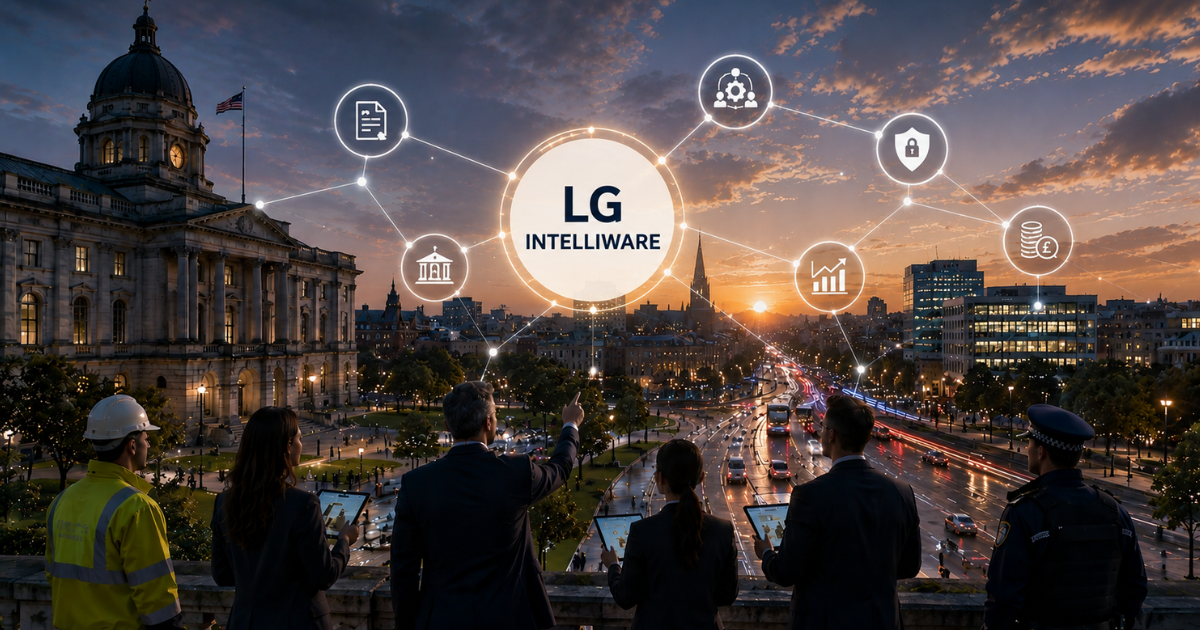
This is where LG Intelliware comes into play. Built specifically for councils on Microsoft’s enterprise platform, LG Intelliware brings together everything that typically works in isolation.
It creates a unified hub where residents can access services 24/7, where staff have complete visibility into every interaction, where routine work happens automatically, and where decisions are informed by real data.
Understanding Local Government Automation and Its Components
LG Intelliware delivers three core capabilities that fundamentally change how councils operate.
First: The Resident Portal
Citizens expect services that modern companies offer. The LG Intelliware resident portal delivers exactly that: online submission, real-time tracking, instant payments, complaint monitoring, and access to a knowledge base. All available 24/7 from any device.
When residents see exactly where their application is, receive automatic updates, and download permits instantly, their perception shifts completely. They experience a modern organization.
Second: The Unified Staff Dashboard
Council employees juggle five systems, check multiple emails, and search for resident information. The LG Intelliware dashboard changes this.
A single dashboard shows all resident interaction calls, emails, messages, and portal submissions.
Staff immediately see the full history of previous complaints, permits, and payments. They understand context without having to ask residents to repeat themselves.
Automated suggestions propose next steps. Integration with back-office systems means information flows automatically.
Staff productivity increases dramatically. What took an hour now takes fifteen minutes. Complex issues have relevant information ready. Staff transition from frustration to confidence.
Third: The Automation Engine
Most council work is routine and predictable. Complaints need categorization. Applications need validation. Payments need matching. These shouldn’t require human time.
LG Intelliware automates exactly these processes. When a complaint arrives, AI categorizes it, routes appropriately, checks for duplicates, assigns priority, and notifies residents immediately.
For permits, it validates that documents exist before staff review. For billing, payments are matched automatically. All without staff intervention, freeing human attention for work requiring judgment and expertise.
The Business Case: Smart Government Software Benefits
Understanding why councils implement systems like LG Intelliware requires looking at concrete numbers. This isn’t an abstract efficiency gain. This is a measurable, significant financial impact.
Implementation Investment: For a mid-sized council (300,000 residents, 800 staff), implementation cost typically ranges from £300,000 to £500,000. This includes software licensing, professional services, training, and hardware. It’s a substantial investment. It’s also recoverable surprisingly quickly.
Annual Savings After Implementation: Councils realize £400,000 to £600,000 in annual savings once fully operational. Where does this money come from?
Staff costs are reduced because productivity increases by 25-35%. Process automation enables the same team to handle 35% more applications. You don’t necessarily eliminate jobs; you handle significantly more work without expansion.
Return on Investment Timeline: Most councils recover their implementation investment within 12-18 months. After that threshold, it becomes pure savings. Year two, year three, year four, the benefits continue indefinitely while ongoing costs remain relatively flat.
The financial case is straightforward: the system pays for itself, then generates sustained value indefinitely.
Real-World Impact: Building Permits Transformed
Understanding how digital transformation actually works requires seeing it in action. Consider building permits, often the most painful service a council offers.
The Traditional Process: A resident submits a form (if they can figure out where to get it). Staff receive the form, manually enter information into a system, check for required documents, request missing documents, wait for a response, and eventually send the completed application to the planning department.
Planning reviews, realizes they need input from building control, and manually requests that. Building control reviews separately and responds. Planning incorporates feedback. Finally, after 120+ days, a decision is made. The resident is notified by mail or must call to ask the status.
Throughout this process, multiple people touch the same application, multiple systems are involved, information is retyped multiple times, the resident has zero visibility into progress, and staff spend time on routing rather than actual review work.
With LG Intelliware: A resident goes online, and the portal guides them through a form tailored to their specific project type. The system automatically validates that all required documents are present.
If something is missing, it immediately tells them exactly what’s needed. When documents are uploaded, building control sees the application automatically and begins review in parallel with planning, not sequentially waiting for planning to finish first.
Implementation: How Councils Actually Do This
Many councils hesitate because they assume implementation is disruptive and risky. Reality is different when properly managed.
Best practice implementation uses a phased approach:
Months 1-3: Foundation. Technology is set up behind the scenes. Systems are connected. Staff receive initial training. Data is prepared. No resident-facing changes occur yet. Old systems continue operating entirely.
Months 4-6: Pilot Launch. One service launches with a limited resident audience perhaps one geographic area or a single service type. Staff handles all inquiries. Feedback is gathered. Problems are identified and fixed while impact is contained. Old systems continue serving everyone else.
Months 7-12: Expansion. Based on pilot learnings, additional services launch. Staff training expands. More residents transition to digital services. Confidence builds. Old systems are gradually phased out as new system proves itself.
Month 12+: Optimization. Continuously improve processes. Add new capabilities. Refine based on real usage patterns. Sustain operations with ongoing support.
Throughout this entire timeline, old systems keep working. Risk is managed. Staff transitions happen gradually. Residents always have options they can use the new system or traditional methods.
The Resident Experience: Why Citizens Embrace Digital Services
Many councils worry: “Will residents actually use online services?”
The answer, consistently, is yes enthusiastically. When services are convenient, transparent, and actually work well, residents prefer them to calling. With LG Intelliware, usage patterns are clear:
- Year one: 30-40% of eligible transactions move online
- Year two: 55-70% of transactions online
- Year three: 70%+ prefer digital services
Residents don’t resist digital services. Residents resist confusing, poorly-designed digital services. When the system actually makes their life easier they embrace it immediately.
The Path Forward: Making the Decision
Councils in 2026 face a choice. They can continue operating with fragmented systems, manual processes, frustrated residents, and burned-out staff. Or they can modernize. There is no middle ground technology is moving forward regardless.
LG Intelliware and similar platforms represent what modern local government looks like: integrated, automated, resident-centric, data-driven, and genuinely efficient.
The technology is mature and proven. Other councils are doing it successfully. The ROI is clear. The implementation path is well-established.
The only question is: How soon will your council make this decision?