
Ask ten data people how to get information into Power BI, and you’ll start an argument. Not about the visuals, or the model, or even the DAX.
About something far less glamorous, how the data gets cleaned and shifted into place before any of that happens.
That argument nearly always lands on two letters swapped around. ETL, or ELT.
Do you transform the data before you load it, or load it first and tidy it up afterwards? Sounds like splitting hairs. It really isn’t. Choose the wrong one for your situation, and you’ll be paying for it months later.
So, let’s settle the ETL vs ELT question properly. This guide runs through the ETL/ELT basics, what each term means, where they part ways, which tools are worth your time, and how to decide, with one eye on how Microsoft Fabric has shaken things up for Power BI users in 2026.
What Does ETL Stand For and What Is the ETL Meaning?
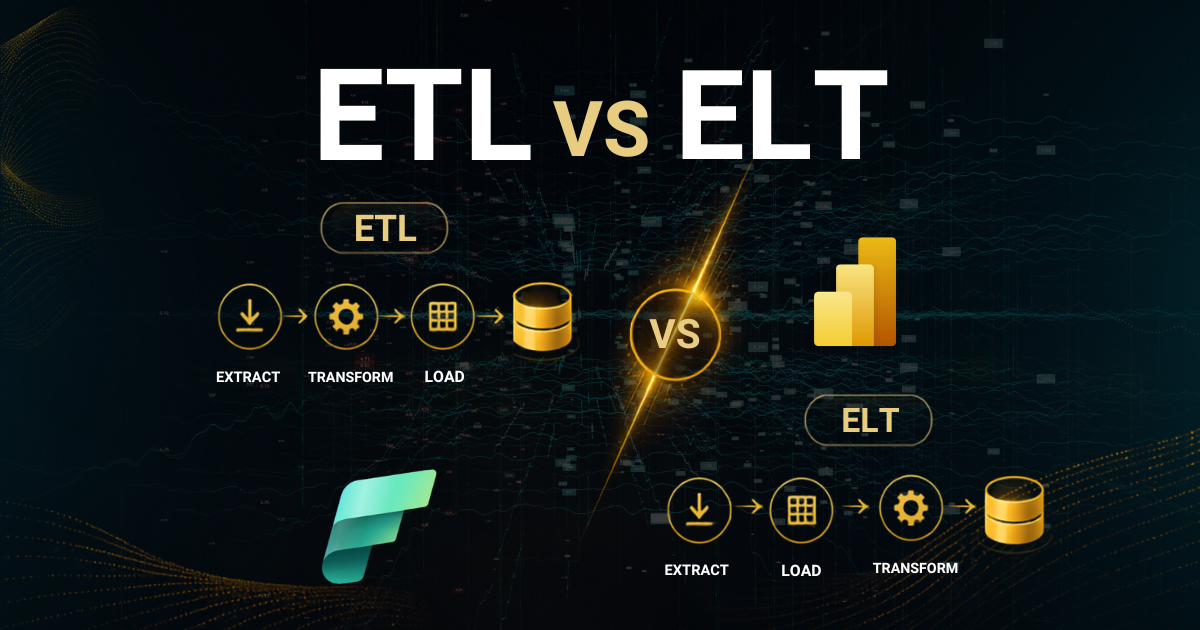
First, the groundwork, because the ETL meaning catches more people out than you’d expect. What does ETL stand for? Extract, Transform, Load. Three steps, run in that order.
- Extract. Grab the data from wherever it lives, a CRM, a spreadsheet, a database, take your pick.
- Transform. Clean it up. Fix the formats, kill the duplicates, stitch different sources together.
- Load. Drop the polished result into its final home, usually a Power BI model or a warehouse.
The whole behaviour of ETL is that everything gets sorted before the data arrives. What lands is already spotless. It’s a bit like chopping and measuring every ingredient before you so much as turn the hob on.
What Is ELT? Understanding the ELT Process
ELT takes those last two steps and flips them. So, what is ELT? Extract, Load, Transform. You pull the raw data, dump it straight into somewhere powerful like a warehouse or lakehouse, and only then start transforming, using that platform’s own horsepower.
Picture the ELT process in one line — raw data first, cleaning second, all done in the place the data now sits.
Small change, big ripples. But what does ELT mean in business terms, not just technical ones? Here’s the ELT business meaning in plain English — you hang on to every scrap of raw data, you stay free to use it however you like down the road, and you let cheap cloud compute do the sweating.
For any business whose data keeps piling up, that freedom tends to be worth a lot.
Key Differences Between ETL and ELT
Sore it right down, and the ETL ELT choice hangs on a single question, when do you transform the data, on the way in or once it’s landed? Cost, flexibility, scale, all of it flows from there. Here’s the side-by-side.
| Factor | ETL | ELT |
| Transform happens | Before loading | After loading |
| Best suited to | Structured, well-defined data | Large, varied, fast-growing data |
| Where the work runs | A separate processing engine | The destination (warehouse/lakehouse) |
| Raw data kept? | Usually not | Yes, all of it |
| Flexibility later | Lower | Higher |
| Typical setting | Legacy systems, strict compliance | Cloud-native, modern analytics |
Don’t read that as one winning and one losing. They’re built for different jobs, and honestly, most decent data teams quietly run both, picking per source. Matching the method to the task beats loyalty to a favourite every single time.
When to Choose ETL
ETL has been the default for decades, and it still earns its spot more often than people give it credit for. It’s happiest where the data behaves, and staying in control beats going fast.
1. Handling Sensitive or Regulated Data
Say you’re working with data that has to be masked or filtered before it can be stored anywhere. A council sitting on residents’ personal records.
A finance team with strict rules about what’s allowed to be kept. Here, cleaning things up before they hit the warehouse isn’t a nice-to-have; it’s usually the law, and ETL gives you one clear point where those rules get applied.
2. Working With Small, Predictable Datasets
ETL also fits smaller, steady datasets where you already know exactly what you’re after. Three tidy systems, monthly sales figures, one report.
The columns barely move, the volumes are small, and the numbers need to line up before anyone lays eyes on them. Shape once, load once, walk away. Anything heavier would be overkill.
When to Choose ELT
Why has the ELT vs ETL debate tilted lately? Simple. Cloud storage got dirt cheap, and cloud compute got seriously strong. The moment both of those were true, loading everything first and sorting it later went from wasteful to smart.
1. Managing Large, Fast-Growing Data
ELT earns its keep when data is big, messy, or flooding in from a dozen places at once. The transformation runs on the destination’s own compute, so it grows with your data instead of gasping under it. Double your sources overnight, and a well-built ELT setup shrugs it off, whereas an old ETL job would grind to a halt.
2. Building a Foundation for AI
And there’s the long game. Keep the raw data, and a question someone throws at you six months from now can often be answered from what’s already sitting there. For teams edging towards AI and heavier analytics, that raw layer is gold, the kind you can’t dig back up once you’ve thrown it out.
Popular ETL Tools to Know in 2026
Whatever camp you fall into, the tooling shapes how smoothly it all goes. If you’re jotting down an ETL tools list, split it into two categories — the Microsoft-native stuff and everything else.
Inside the Microsoft world, the everyday ETL tools are Power Query (baked into Power BI), Azure Data Factory, and Dataflows Gen2 in Microsoft Fabric. For most Power BI work, those three alone get you a very long way.
Look wider, and the best ETL tools and popular ETL tools people lean on include Informatica, Talend, Fivetran, Matillion and dbt, the last two very much part of the modern ELT crowd.
Search for the top ETL tools, and you’ll see those names on repeat. But “best” is slippery; it always depends on your data, your budget and whatever you’re already running.
Not sure which one fits? That’s a chat worth having with someone who’s done it before, rather than a punt made under deadline. A tool that’s spot-on for a data-drowning retailer can be laughably over-engineered for a small charity running five reports.
And remember — the tool and the approach are two separate calls. Most modern platforms handle both ETL and ELT happily, so picking Azure Data Factory or Fabric doesn’t hitch you to one style for life.
ETL and ELT in Power BI and Microsoft Fabric
Here’s where 2026 rewrites the story. The Microsoft ecosystem tilts far harder towards ELT than it did a couple of years back, and that nudges the whole decision.
1. Power BI’s Traditional ETL Roots
Old-school Power BI leaned on ETL through Power Query. Shape the data coming in, load the neat result into your model, job done. That still works a treat for loads of reports, and it’s not disappearing anytime soon.
2. How Microsoft Fabric Tips the Balance Towards ELT
Fabric has dragged the whole ecosystem ELT-ward. Stick a Lakehouse or Warehouse underneath, and you can load raw data at scale, then transform it right where it sits. Dataflows Gen2, OneLake and Fabric’s compute make load-first, transform-later feel like the obvious move rather than a workaround.
For most organisations, the real answer is a mix, and getting that mix right is where know-how pays off. As a Microsoft data and analytics partner, we help teams build pipelines that suit their actual world, not a textbook.
Our BI and Data Science services turn scattered, raw data into insight people trust, while our Azure Integration services keep it flowing cleanly across Dynamics 365, Azure and Power BI.
How to Choose Between ETL and ELT
If it still feels a bit theoretical, a handful of honest questions about your own setup usually clear the fog.
Look at the data first. Is it structured and predictable, or big, messy and growing fast? Tidy data leans toward ETL. Sprawling data leans toward ELT.
Now, does compliance require anything to be masked before it’s stored? If yes, ETL’s transform-first habit earns its keep. Then, in the future, do you want to hang on to raw data for questions or AI work you haven’t dreamt up yet? That’s a solid shove towards ELT.
Lastly, your platform. Already on Fabric with a Lakehouse? ELT will feel like home. Running smaller Power Query pipelines? ETL might be the cleaner road.
Nearly everyone ends up on a sensible blend, and having the right Power Platform development support behind you makes that blend far easier to pull off.
Making the Right Choice for Your Business
There’s no universal answer here, and anyone who hands you one hasn’t looked at your data. It comes down to what you’re working with, how fast it’s growing, and what you’re planning to do with it next.
Rough steer structured, sensitive, stable data? ETL will make you proud. Big, varied, with an eye on AI and deeper analytics? ELT is usually the smarter play. And plenty of businesses sit right in the middle, which is completely fine.
The thing that matters is that you choose, rather than drifting into it by accident. A solid data foundation is the line between a Power BI setup that limps along and one your people genuinely rely on.
If you’d like a hand shaping yours, or you’re getting your data estate ready for AI, our AI Enablement Programme and data specialists can help you build it properly from the ground up.
Book a free assessment, and we’ll map out the smartest path for your data.
Frequently Asked Questions
What does ETL stand for?
Extract, Transform, Load. Data gets pulled from a source, cleaned and reshaped, then loaded into a destination like a Power BI model or warehouse. That’s the entire ETL meaning in a sentence.
What is ELT, and how is it different?
Extract, Load, Transform. The difference is all about timing. ELT loads the raw data first and transforms it afterwards inside the destination, while ETL does the transforming beforehand. That gap is the heart of the ETL vs ELT debate.
What is the ELT business meaning?
Flexibility, basically. By keeping all your raw data and shaping it later, you stay free to answer new questions and feed AI projects further down the line, without trekking back to the source every time.
Which is better, ETL or ELT?
Neither, flat out. ETL suits structured, sensitive, stable data. ELT suits big, fast-moving data and cloud-first analytics. Plenty of teams run both, and that’s completely normal.
What are the best ETL tools for Power BI?
For Power BI, start with Power Query, Azure Data Factory and Dataflows Gen2 in Fabric, then look at third-party names like Fivetran, Talend or dbt if your needs push you there.
Does ELT replace ETL entirely?
No. The ELT process is growing fast thanks to the cloud, but ETL is still the better bet for sensitive, regulated or smaller datasets. Most mature teams run a healthy mix rather than betting everything on one.