
Picture this. It’s Tuesday morning, and your inbox is already full. Customers are asking for order status updates. Questions about pricing.
Billing inquiries. Issues that should take five minutes to resolve. Your team spends the entire day answering emails, running in circles, and never actually finishing anything.
By Friday, nothing has progressed. Customers are frustrated because their simple questions took three days to answer.
Your team is exhausted because they spend their entire week on repetitive work rather than building genuine customer relationships. Meanwhile, competitors with smarter systems are handling the same volume with half the staff.
This is the reality most organisations face. Customer support is drowning in routine work, teams are frustrated, and customers are disappointed. Everyone is stuck in a cycle that wastes time and money.
Beyond Simple Chatbots
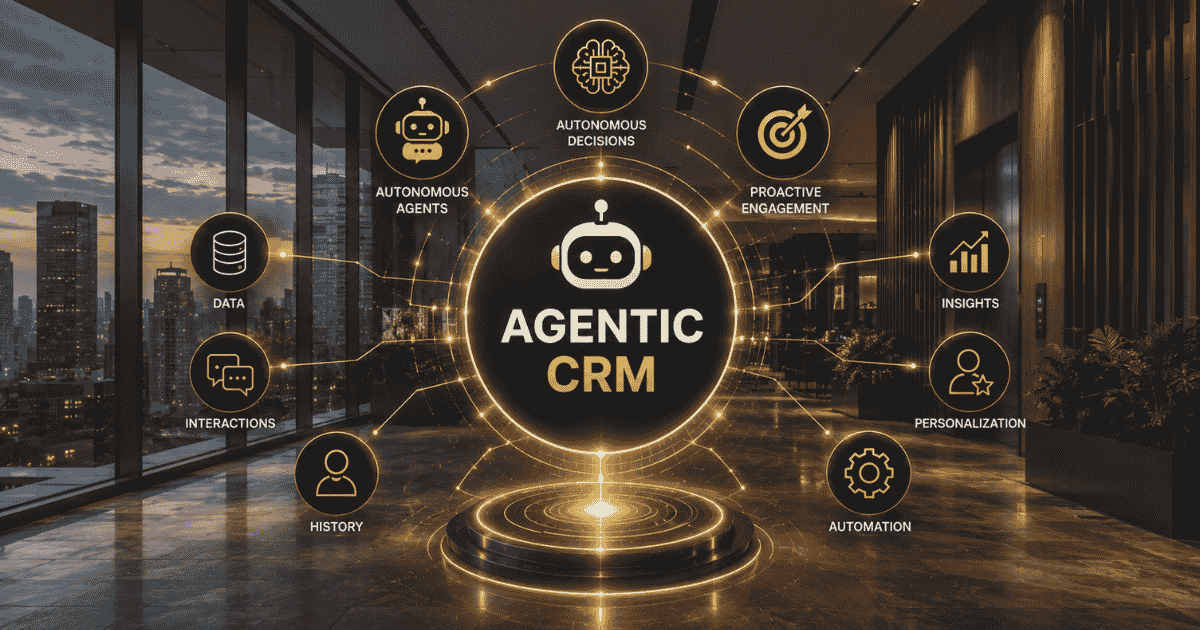
Autonomous agents work differently. They don’t wait for instructions. They actively work toward business goals. An autonomous agent can review a customer’s account, understand their history, anticipate needs, implement solutions, and follow up, all without human intervention.
Traditional chatbot: a digital assistant that answers when you ask.
Autonomous agent: a digital employee that solves problems independently.
Transforming Customer Service Today
The old way. Customer emails. Your team reads it. Someone searches for your system. They draft a response. Customer waits hours. They reply again. The cycle repeats.
Multiple people touch the same issue. Information is passed between systems. Delays multiply. The customer grows frustrated. By the time they get an answer, they’ve often tried to contact you multiple times.
With agentic CRM, the customer emails. The autonomous agent reads the email instantly. It accesses the account, understands the context, processes the request, and resolves it. The customer receives confirmation within minutes.
The autonomous agent has all the information it needs immediately. It doesn’t need to escalate to different teams or wait for other systems to respond. It executes the entire resolution independently.
Freeing Your Team for Real Work
Here’s the real value. Your staff no longer has to process routine questions.
Instead, they handle complex issues. They work with frustrated customers who need human empathy. They build relationships with high-value accounts. They identify improvements in the performance of autonomous agents.
Customer service roles transform from “answer this question” to “solve this complex problem.” Staff report higher job satisfaction because they’re doing meaningful work rather than running through scripts.
Why 2026 Matters for CRM
The numbers are clear. Nearly 87% of businesses now prioritise AI for their CRM strategy. Over 93% of IT leaders plan to deploy autonomous agents within two years.
The CRM market is projected to exceed $106 billion by 2029, almost entirely driven by the adoption of agentic AI.
This isn’t hype. Organisations implementing autonomous agents gain competitive advantages they can’t ignore.
They handle customer inquiries at scale without scaling staff. They offer 24/7 support without 24/7 staffing costs. They respond faster than competitors still using traditional systems.
The Learning Advantage
Autonomous agents improve over time.
Each customer interaction teaches the system. The agent learns what works and what doesn’t. The system refines its approach. It gets faster at resolving issues. It improves at recognising when human escalation is needed.
Machine learning models embedded in the system become more accurate with each interaction. The system identifies patterns. It understands which solutions work best for different customer types. It learns customer preferences and communication styles.
This means your first month isn’t your best month. Month three is better. Month six is significantly better. By month twelve, the system has processed thousands of interactions and dramatically improved its effectiveness.
The ROI continues to improve every month at no additional cost. You’re not paying more for better performance; the system gets smarter automatically.
Microsoft Dynamics 365 Integration
If you’re running Dynamics 365 CRM, autonomous agents aren’t distant future technology.
Microsoft is integrating autonomous capabilities directly into Dynamics 365 via Copilot and the Power Platform. The technology is already available. It’s built into the system you already use.
Your agents work within the interface they know. Your data flows naturally. Your business logic doesn’t require rebuilding. Autonomous agents connect seamlessly to existing workflows and customer records.
This matters because complex implementations typically fail. Organisations struggle when new systems don’t integrate with existing infrastructure. With autonomous agents integrated into your existing CRM, deployment becomes straightforward. You’re adding capability to proven systems, not replacing them.
Does AI Replace Your Team?
The concern is real. Will autonomous agents eliminate customer service jobs?
The honest answer is that they don’t eliminate jobs. They transform them.
Organisations deploying autonomous agents don’t fire their teams. They redeploy them to higher-value work. Instead of answering emails all day, staff handle complex problems, build relationships with key accounts, and identify process improvements.
Turnover typically decreases because the work becomes more meaningful. Staff satisfaction improves because they’re solving real problems rather than processing routine requests.
The autonomous agent becomes a teammate, not a replacement. The best organisations view AI as an enhancement to human capability, not a competitor to it.
Addressing Customer Concerns
Some customers worry that AI interactions will replace human contact.
Reality is that Customers prefer autonomous agents for simple questions. They offer faster responses, instant answers, and no hold times. But for complex issues, they want your best person.
Modern autonomous agents recognise this boundary. When they detect that something requires human expertise, they transfer immediately, providing your staff with full context.
Your staff member arrives with a full understanding of what happened, what the customer tried, and what the customer needs.
Your customer gets the best of both worlds, with AI handling routine tasks and humans handling complexity.
This hybrid model consistently delivers higher satisfaction than either pure AI or pure human service alone. Customers appreciate efficiency and value human judgement when needed.
Getting Started
Implementation doesn’t require massive disruption. Our AI Enablement Programme helps organisations progress from AI experimentation to production-ready deployment.
Begin by identifying standard customer interactions. Which questions are frequently asked? Which processes adhere to predictable patterns? Which do not necessitate complex judgment? These are the areas where autonomous agents provide the greatest immediate value.
Deploy gradually. Start with a single process. Let the system learn. Measure results. Expand methodically. Our D365 Consulting team can guide you through this journey.
For deeper technical implementation, explore our Power Platform Development services and recent insights on automating Dynamics 365 with Copilot Studio.
The Competitive Pressure
By 2026, agentic CRM won’t be an interesting future technology. It’s a current necessity.
Organisations serious about customer engagement, operational efficiency, and competitiveness are deploying autonomous agents now.
The question isn’t whether your organisation will eventually adopt this technology. The question is whether you’ll start this year or spend next year catching up.
Your competitors who move first gain measurable advantages. They serve customers faster. They handle more volume with smaller teams. They continuously improve their systems while yours remain static.
Book a free assessment or claim your free workshop day, and we’ll help you map out where to start, with honest advice, no hard sell.