
Ask a normal AI chatbot about your company’s refund policy and watch it answer without a flicker of doubt. A slight snag. It may have invented the entire thing. Language models are wonderful at sounding right, which is fine until sounding right and being right quietly go their separate ways.
In a business, that’s not a charming quirk. It’s a risk with your name on it. And closing that gap is the whole job of retrieval-augmented generation.
In 2026, it’s become the thing serious organisations build their AI on, rather than just talk about. So, let’s get into how a RAG pipeline works, why it earns its place, and what separates a good one from a demo.
What Is Retrieval-Augmented Generation?
So, what is it, in plain terms? Retrieval-augmented generation, or RAG, hooks a large language model up to your own trusted data before it says a word.
Instead of leaning only on what it picked up in training, the model goes and fetches relevant, current information from your knowledge base the moment a question lands, then builds its answer on that.
That gap matters more than it sounds. A plain LLM answers from memory, frozen at its training cut-off, blind to everything about your business. A RAG system answers from evidence: your documents, your policies, your live records.
As IBM explains, it retrieves the data, folds that context into the prompt, and only then writes a reply. One change, and a clever generalist becomes a specialist you can rely on.
None of this is brand new, mind. The idea first showed up in a 2020 research paper. But its moment has well and truly arrived. Models got sharper, businesses got warier about where they let AI off the leash, and grounding answers in verified data went from a neat trick to non-negotiable.
Why RAG Is Essential for Enterprise AI
Out-of-the-box AI comes with three habits that make businesses uneasy. RAG deals with all three.
Start with hallucination, the knack for inventing answers that sound plausible and simply aren’t. Anchor the model to retrieved facts, and it stops wandering off script nearly as often. Then there’s stale knowledge.
Training has a use-by date; your business moves every day. RAG delivers today’s information to the model without the eye-watering cost of retraining. And finally, trust, which might matter most of all. Because an RAG system answers using named sources, it can cite them, so people can check where an answer came from instead of just crossing their fingers.
Boil it down, and RAG is the line between an AI you show off in a meeting and one you put into production. That’s why it’s stopped being a talking point and, for many, has become a flat-out requirement for enterprise AI.
Understanding the Structure of a RAG Pipeline
A real pipeline is two journeys. One runs quietly in the background. The other kicks off the second someone types a question.
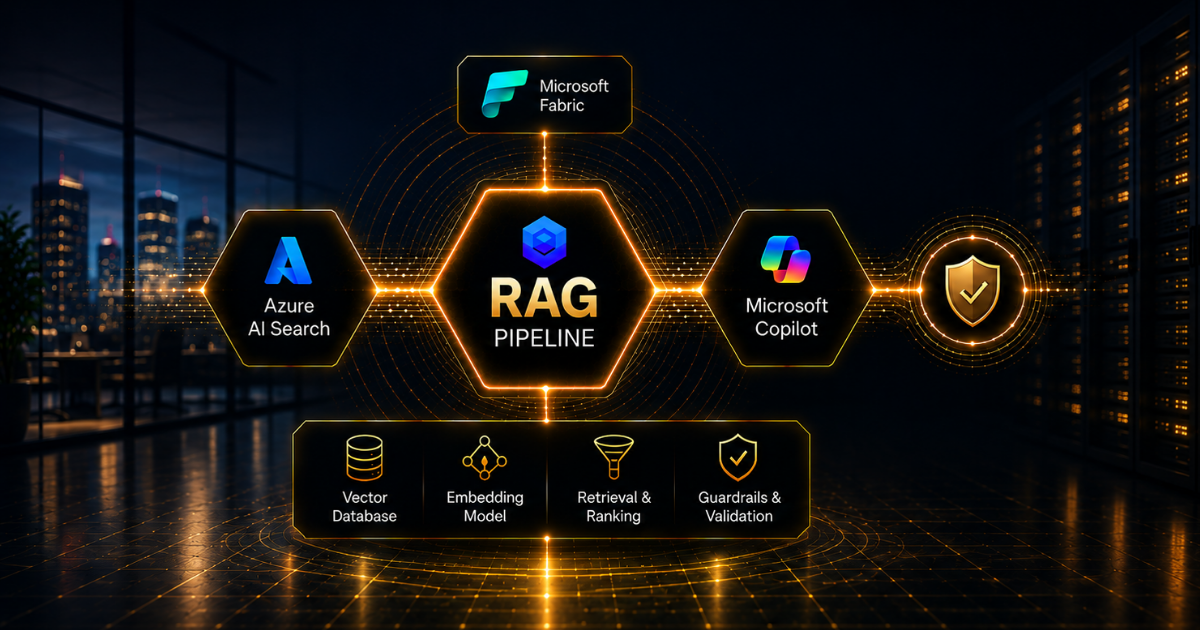
The background one is ingestion. Your documents, contracts, manuals, policies, support tickets, get loaded in, sliced into sensible chunks, turned into numerical fingerprints called embeddings, and parked in a vector database.
Think of it as your AI’s searchable memory. Get this stage right or wrong, and you’ve quietly decided how good everything downstream will be.
The live one is retrieval and generation. Someone asks a question, the system hunts through that vector store for the chunks that fit best, bundles them with the original question into a beefed-up prompt, and passes the whole lot to the model.
Out comes an answer shaped by your real data, usually with the receipts attached.
The steps, in order, look like this:
- Ingest your trusted content into a knowledge base
- Chunk it into passages the system can search precisely
- Embed those chunks so meaning, not just keywords, can be matched
- Retrieve the most relevant passages for each question
- Generate a grounded, source-backed answer
Fumble the craft on any single one, and accuracy pays for it. That’s the reason a RAG pipeline is a doddle to prototype and a proper challenge to perfect.
The pattern keeps evolving, too, which is worth knowing. Agentic RAG lets the AI determine which sources to check and which questions to ask before answering.
GraphRAG maps how pieces of information relate rather than treating each as an island. For most businesses, a solid, classic pipeline is plenty to begin with, but it’s nice to know there’s headroom as your ambitions grow.
Where RAG Meets the Microsoft Stack
If you’re already deep in Microsoft, here’s the good news. RAG isn’t a separate world bolted on the side. It runs on the platform you already use every day.
Within Copilot Studio, knowledge sources provide a lightweight RAG pattern for agents with minimal effort, and we’ve walked through one approach in our guide to using Dynamics 365 entities as a knowledge source.
For heavier, production-grade needs, Azure AI Foundry and Azure AI Search provide vector search, orchestration and controls that enterprise RAG demands.
And when your knowledge lives across many systems rather than one tidy store, custom MCP servers give agents a standard way to reach it.
The upshot? RAG that inherits your existing security, identity and governance instead of sitting awkwardly outside them, which, for most businesses, is the entire point.
Getting RAG Right Is Where the Value Lives
Now the honest bit. A basic RAG demo? An afternoon’s work. One that stays accurate under real questions, real data volumes and a sceptical auditor? A whole different sport.
The tricky problems are almost never the model. They’re the chunking strategy that keeps context intact, the embedding quality that makes retrieval land, the data freshness that stops answers quietly drifting, and the evaluation that proves the thing genuinely works.
Nails and RAG feel like magic. Miss them, and you’ve built a confident liar with a wider vocabulary.
This is the work our AI and Copilot team does day-to-day, designing RAG pipelines with retrieval quality, governance and audit trails built in from the start rather than patched on later.
As an ISO 27001–certified Microsoft partner, Stallions Solutions treats data security as the first design decision, which matters enormously when your AI is reading your most sensitive documents.
Final Thoughts
Retrieval-augmented generation is the line between enterprise AI you can trust and AI you’re merely hoping about.
Ground every answer in your own verified data, and a well-built RAG pipeline gives you responses that are accurate, current and, above all, checkable. In a year, when AI is moving from experiment to core infrastructure, that kind of reliability will no longer be optional.
If you’re ready to build AI that answers from your business rather than guessing about it, that’s exactly where we can help.
Book a free assessment, and we’ll map out where RAG can deliver the most value-honest advice, no hard sell.
Frequently Asked Questions
What does RAG stand for?
RAG stands for retrieval-augmented generation. It’s an AI technique that retrieves relevant information from your own data and uses it to ground a language model’s response, improving accuracy and reducing hallucinations.
How does RAG reduce AI hallucinations?
By retrieving factual, relevant content from a trusted knowledge base and feeding it to the model at query time, RAG anchors answers in real evidence rather than in the model’s memory, thereby sharply reducing the likelihood of invented responses.
Is RAG better than fine-tuning a model?
They solve different problems. RAG is ideal for keeping answers current and grounded in changing data, while fine-tuning adjusts a model’s style or specialist behaviour. Many enterprise solutions use both together.
Can RAG work with my existing Microsoft tools?
Yes. RAG patterns run through Copilot Studio knowledge sources, Azure AI Foundry, and Azure AI Search, so they fit naturally into an existing Microsoft 365, Dynamics 365, and Azure environment.
Is my data safe in a RAG system?
It can be, provided the pipeline is built with proper governance, identity controls, and data-handling rules, which are essential when the system reads sensitive business content.