
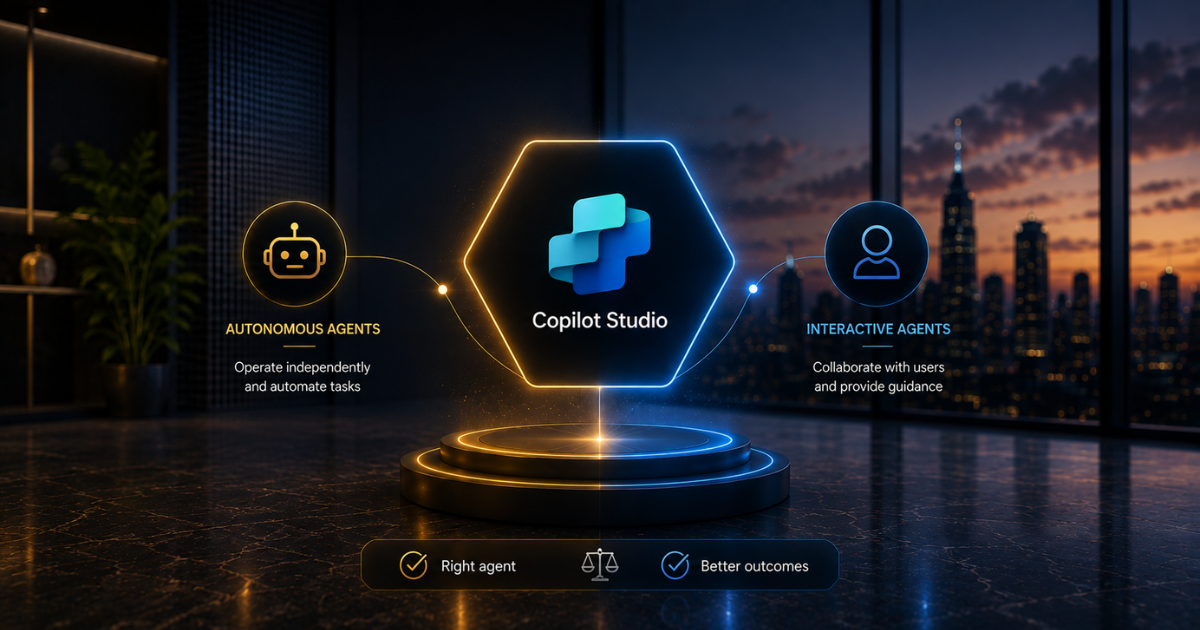
Your organisation needs intelligent automation. You’ve heard about Copilot Studio agents, which sound ideal for streamlining workflows and enhancing customer service. But there’s a decision you need to make first, and it’s not obvious.
Should you build autonomous agents that act independently, or interactive agents that collaborate with humans?
Get this wrong, and you’ll either end up with automation that’s too conservative to add value, or with systems that operate without human oversight and create problems. Get it right, and you unlock genuine competitive advantage through intelligent workflow automation.
The difference between these approaches isn’t just technical—it’s strategic. Understanding when to use each approach affects how effectively your organisation implements AI.
Understanding the Two Agent Types
Copilot Studio offers two different agent architectures, each suited for particular scenarios. It’s not about which one is better, but about matching the technology to the business requirements.
Autonomous agents make decisions and act independently. You define the rules and guidelines. The agent operates within those parameters without awaiting human approval. It completes workflows end-to-end, adapts to different situations, and solves problems without escalation unless specifically configured to escalate.
Interactive agents engage users in conversation. They gather information, make recommendations, and guide users through decisions, but humans make the final call. The agent informs and assists. The human remains in control.
Think of autonomous agents as trusted employees who handle routine work independently. Interactive agents are trusted advisors who help employees make better decisions.
The Autonomous Agent Advantage
Autonomous agents shine when workflows are predictable and the cost of errors is low. They excel at speed and efficiency. Your workflows run faster because there’s no human bottleneck. Your team can handle larger volumes because automation scales without adding headcount.
Where autonomous agents create real value:
- High-volume routine transactions. Expense report processing, invoice approvals below spending thresholds, and standard customer service requests are completed instantly without human intervention.
- Time-sensitive responses. Customer issues requiring immediate answers are addressed in seconds, not hours, by autonomous agents.
- Consistent decision-making. Unlike humans, who may apply rules inconsistently from day to day, autonomous agents apply logic uniformly every time.
- Cost reduction. Your team stops handling routine work and focuses on complex, high-value activities.
An insurance company uses autonomous agents to adjudicate straightforward claims instantly. A claim comes in. The agent verifies information. The agent checks policy coverage. The agent approves payment. All within minutes. Complex claims escalate to humans, but 60-70% of claims resolve autonomously.
This provides real business value. Customers find answers more quickly. Your team can address more complex issues. Your operational costs decrease.
The Interactive Agent Reality
Interactive agents solve a different problem. They enhance human decision-making rather than replace it. Your teams receive smarter assistance while retaining control and accountability.
Where interactive agents add value:
- Complex situations requiring judgement. Sales negotiations, strategic decisions, and customer situations with unique nuances—these require human wisdom combined with AI insights.
- High-stakes decisions. Any situation where errors carry significant consequences. Humans retain authority because accountability matters.
- Compliance and regulated industries. Financial services, healthcare, government—regulatory requirements often demand human accountability for critical decisions.
- Customer relationships. Your teams use interactive agents to deliver better service while maintaining personal relationships.
A financial services company deployed interactive agents to help advisors manage client portfolios. The agent gathers client data, analyses market conditions, and makes recommendations.
Nevertheless, the advisor thoroughly reviews all aspects before acting. This approach combines machine intelligence with human judgement, yielding better outcomes than relying on either alone.
Clients appreciate that a qualified human understands their situation. Your advisors make better decisions because they have access to comprehensive AI-generated analysis. The agent handles research that would otherwise take hours to complete manually.
Making the Decision: Key Factors
Choosing between autonomous and interactive agents depends on several factors. There is no universal rule. Your specific situation determines the right approach.
Predictability of situations. When will you encounter situations like training scenarios? Are edge cases common or rare? Autonomous agents work brilliantly when situations are predictable. Interactive agents handle unpredictability better because humans can recognise unusual circumstances and adapt to them.
Cost of errors. If the agent makes a mistake, how serious is it? Expense report errors are minor. Wrongly denied insurance claims create serious problems. Critical decisions favour interactive agents, whereas routine decisions can be autonomous.
Customer expectations. Some customers want instant answers from automation, while others expect to speak with a human who understands their situation. Know your customers. Their preferences influence the right architecture.
Regulatory requirements. Certain industries require human oversight for accountability. Financial services, healthcare, government—these sectors often demand interactive approaches for sensitive decisions.
Volume and speed requirements. Need to handle 10,000 customer requests daily? Autonomous agents scale. Need to maintain personal relationships with 50 key clients? Interactive agents preserve the personal touch.
Your Power Platform Development and AI Enablement Programme teams help organisations evaluate these factors and choose the right architecture for their specific context.
Implementation Patterns: Autonomous Agents
Building effective autonomous agents requires careful design. You’re defining the rules the agent will follow when you’re not watching.
Start with high-confidence workflows. Begin with processes you know the rules for and can predict most situations. Standard approvals, routine data entry, and straightforward customer requests—these are safe starting points.
Define clear escalation paths. Even autonomous agents need escape routes. When the agent encounters something outside its rules, escalate to a human. This prevents the agent from making poor guesses. Your team handles genuinely unusual situations.
Monitor performance religiously. Track decision accuracy, escalation rates, and customer satisfaction. Autonomous agents improve over time as you refine rules, but they still require active oversight. Don’t set up the agent and forget it.
Build feedback loops. When the agent makes mistakes, you learn where the rules are incomplete. Continuously improve your decision logic based on what happens.
A government agency processing permit applications deployed autonomous agents for standard submissions. The agent verifies required documents, checks for completeness, and processes approvals.
Complex applications with special circumstances are escalated automatically. The agency processes 40% more applications with fewer staff.
Implementation Patterns: Interactive Agents
Interactive agents require different implementation thinking. You’re enhancing human decision-making, not replacing it.
Focus on information quality
The agent’s value stems from providing better information and analysis. Excellent data gathering, comprehensive analysis, and clear recommendations deliver user value.
Design for human workflow
Where does the agent fit naturally within your team’s existing process? The agent that integrates seamlessly with how people already work gets adopted. The agent that adds extra steps gets avoided.
Train your team thoroughly
Interactive agents require users to understand what the agent can and cannot do. Under-trained users either ignore the agent or trust it too much. Proper training is critical.
Measure impact on human performance
Better decisions? Faster completion? Higher customer satisfaction? Interactive agents should improve measurable outcomes for your team.
Our D365 Consulting team has implemented interactive agents that help financial analysts make faster, better decisions.
The agent conducts market research, evaluates competitors, and creates scenarios. Analysts provide quicker recommendations to clients, resulting in higher customer satisfaction due to better advice.
The Hybrid Approach: Best of Both Worlds
The most advanced organisations don’t pick one approach; instead, they integrate both. Various workflows employ different types of agents.
A large enterprise might deploy:
• Autonomous agents for routine transactions (expenses, standard approvals, basic customer service)
• Interactive agents for situations where judgement matters (complex sales, strategic decisions, high-value customer interactions)
• Escalation paths between them (routine work that becomes complex automatically escalates to interactive mode)
This architecture maximises efficiency while preserving human control where it matters. Your routine work disappears. Your team’s judgement adds value where it counts.
Building this requires sophisticated integration, but Azure Integration Services can guide the architecture and implementation.
Making Your Choice with Confidence and Care
Autonomous agents deliver speed and efficiency when situations are predictable and errors are tolerable. Use them for high-volume, routine work.
Interactive agents preserve judgement and accountability. Use them where human wisdom matters and customer relationships are critical.
Most organisations benefit from both, deployed strategically across different workflows.
FAQs
Can we start with interactive agents and move to autonomous later?
Absolutely. Many organisations start with interactive agents to understand how they work and the value they deliver. As confidence grows and processes are refined, certain workflows transition to autonomy. This approach lets you learn before fully committing.
What happens when an autonomous agent makes a mistake?
Autonomous agents should escalate to humans whenever they face situations beyond their predefined rules. However, errors can occur. Your monitoring systems detect these mistakes and use them to refine the rules. Begin by deploying autonomous agents on low-risk workflows as you gradually build trust and confidence.
Are autonomous agents really safe in regulated industries?
They can be, with proper implementation. However, regulations often require human accountability for critical decisions. In healthcare and financial services, interactive agents are typically the safer choice for compliance reasons.
How do we know if an interactive agent is actually helping?
Track measurable outcomes. Are decisions faster and more accurate? Are customers happier? Do your team members use the agent? These metrics indicate whether the agent delivers value or remains idle.
Can one agent handle both autonomous and interactive work?
Not really. They’re different architectures that require different designs. An agent designed to be autonomous doesn’t work well in interactive mode because it expects to act independently. Design each agent for its specific purpose.