
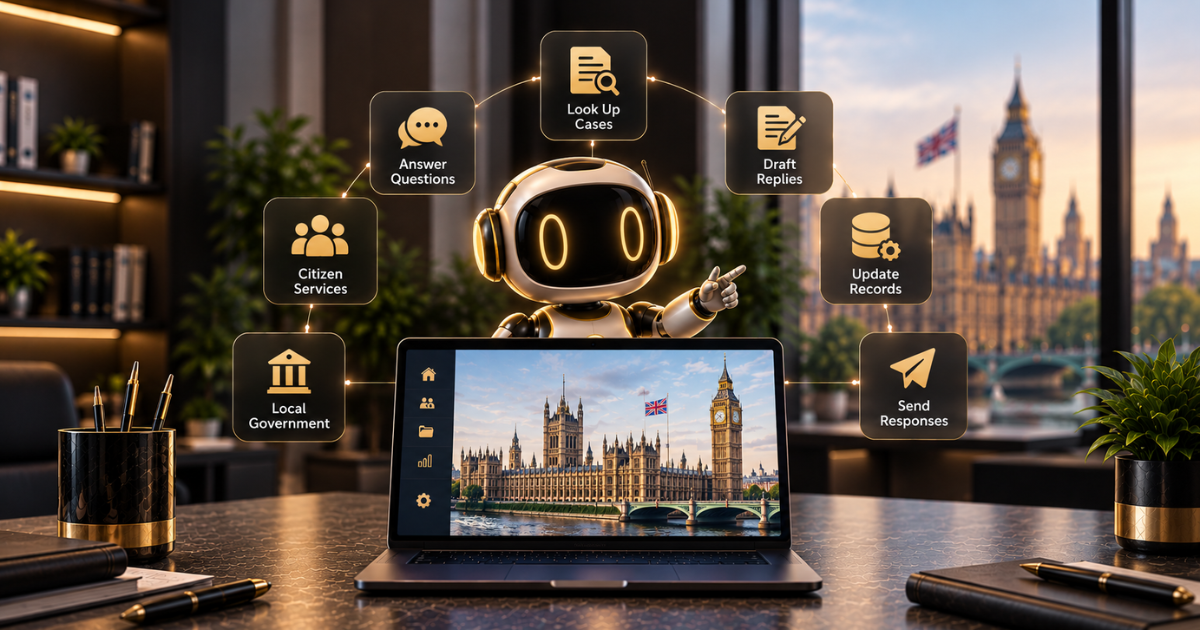
A chatbot answers a question. An agent looks up the case, drafts the reply, updates the record, and sends it. The first gives an officer some words to check. The second acts within your systems, in the council’s name, and may not wait for anyone to look first.
That difference is why the Local Government Association published a playbook on agentic AI in October 2026. It urges councils to be ambitious but risk-aware, and it’s a fair summary of where most councils actually sit.
They can see the benefits, they’re short of time and money, and they’d rather not be the case study of what went wrong. This guide covers where to begin with AI agents in local government, what the rules look like in the UK, and how to govern them without grinding everything to a halt.
It sits alongside our practical AI adoption roadmap for UK councils, which covers the wider programme.
Why Agents Need Different Thinking
Most council AI so far has been assistive. Someone asks Copilot to summarise a report, a person reads the summary, and the person decides. The human is in the loop at every step.
Agents change that. They plan a series of steps, use tools, and carry out the work with limited human input. The Government’s own AI Playbook describes agentic AI as autonomous systems that can make decisions and perform tasks, and that autonomy is exactly what makes governance matter more.
The LGA playbook is candid about the consequence: it accepts that constant human oversight isn’t always realistic once agents are working at pace, so councils have to design their controls with some level of trust.
The Local Government Lawyer’s report summarises the guidance, which sets out 11 recommended principles covering procurement, accountability, training and cyber security.
Where to Start
Start where mistakes are cheap and easy to spot. In our experience, that means working on staff tasks, not making decisions about residents.
Good first candidates include summarising case notes for an officer, drafting replies for a person to check, routing incoming enquiries to the right team, preparing meeting packs, and answering staff questions using your own policies.
Leave decisions that affect an individual’s rights, such as benefits, housing eligibility or safeguarding, for later, and keep a person firmly in charge of them when you get there.
Our guide to cutting council admin time with Copilot and automation covers where the safe early wins usually sit.
It also helps to think in steps rather than a switch. This is our suggested ladder, and you can stop at any rung.
| Stage | What the agent does | Who checks |
| Read and summarise | Reads records and reports, changes nothing | Officer uses the summary as a guide |
| Draft | Prepares replies, notes or letters | Officer reviews before anything is used |
| Act with approval | Updates records or sends messages | Officer approves each action |
| Act alone | Low-risk, reversible tasks only | Spot checks and audit logs |
Most services will sit comfortably at the second or third rung for a long time, and that’s fine.
What the Rules Look Like
There’s no UK AI Act. The Government has asked existing regulators to apply five cross-sector principles (safety, transparency, fairness, accountability and contestability), and a dedicated AI Bill hasn’t arrived. That doesn’t mean councils are in a free-for-all, because the rules that already apply are quite demanding.
As a data controller, a council remains responsible under UK GDPR and the Data Protection Act 2018 for lawfulness, fairness and a data protection impact assessment, and for the right to human review where automated decisions are involved.
The Public Sector Equality Duty also requires an equality impact assessment. Responsibility remains with the council, not the supplier.
A Governance Checklist
None of this needs to be heavy. The practical checks come from the LGA’s thinking and from what we see working.
- Keep an inventory. One central list of every AI use case across the council, so nothing is running unseen in a single department
- Name the owners. A service owner, a technical owner and someone responsible for information governance, with a clear route for escalation
- Decide what can run automatically. Be explicit about which tasks an agent may do alone and which need an officer’s judgement or approval
- Complete the assessments first. A DPIA and an equality impact assessment before go-live, not after
- Give every agent an identity. Its own account, its own permissions and a record of what it did, which we explain in our guide to securing AI agents with Microsoft Entra ID and our overview of Microsoft Agent 365
- Plan for things going wrong. An incident process that says who stops the agent and who tells residents
- Keep reviewing. Governance doesn’t end when a system goes live
The principles behind this are the ones in our guide to responsible AI in practice, and the environment controls in governing the Power Platform at scale apply to agents you build there too.
Keeping Residents’ Trust
A council can be technically compliant yet still lose public confidence. People tend to forgive a mistake they were told about and resent one they were kept in the dark about.
So tell residents when an agent is involved, ensure there’s always a route to a real person, and consider those who can’t or won’t use digital channels. Publishing a plain-English record of what each agent does, in line with the transparency standard, costs little and builds trust.
The Local Government Association’s AI hub is a good place to find current guidance and examples from other councils. And agents depend on joined-up information, so it’s worth tackling the data first, as we cover in our guide to solving data silos in local government.
Final Thoughts
Agents can help councils do more with less, but the LGA is right that this isn’t primarily a technology challenge.
The councils that do well will have clear ownership, clean data, honest governance, and a willingness to start small. Climb the ladder one rung at a time, and let evidence decide how far to go.
If you’d like help, our Power Platform development team builds agents with governance designed in, and our AI Enablement Programme takes councils from first experiment to production without the usual false starts.
As an ISO 27001-certified Microsoft partner with public sector experience, we ensure the controls are right before an agent touches resident data. Book a free assessment, and we’ll tell you honestly where to begin, no hard sell.
Frequently Asked Questions
What is agentic AI in local government?
It’s AI that can plan and carry out tasks with limited human input, such as looking up a case, drafting a reply and updating a record, rather than answering only questions.
Where should a council start with AI agents?
Start with staff-facing, low-risk tasks such as summarising, drafting, and routing enquiries, with a person in charge. Leave decisions about individual rights for later and retain human review.
Is there a UK law governing AI agents?
There’s no dedicated UK AI Act. Existing law applies, including the UK GDPR, the Data Protection Act 2018 and the Public Sector Equality Duty, together with regulator guidance. Check the ICO’s current guidance on automated decision-making.
Do councils have to use the Algorithmic Transparency Recording Standard?
It’s mandatory for the central government and certain arm’s-length bodies, and recommended for the wider public sector. Commentators have noted that most councils aren’t currently required to register tools, but publishing a record is good practice.
Who is accountable if an agent gets something wrong?
The council, as the data controller and public body, remains responsible, which is why clear ownership and human accountability matter.