
A lot of council AI plans turn out to be shopping lists. A tool bought here, a licence added there, and a pilot because the authority next door ran one. A year on, someone asks what it achieved, and nobody’s quite sure.
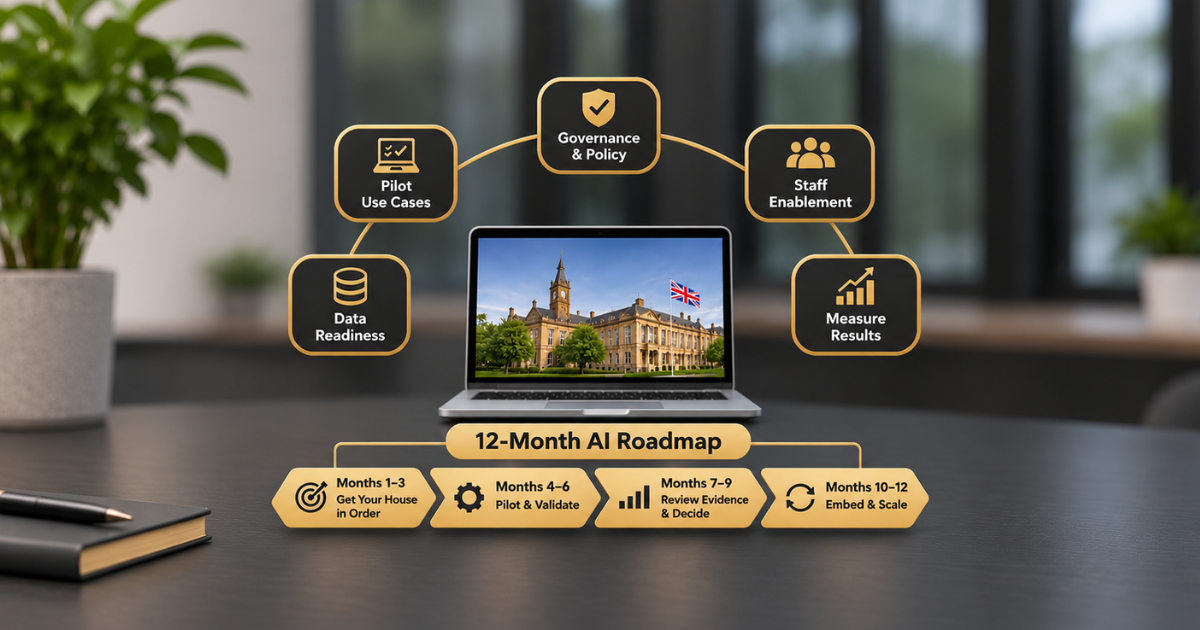
This AI roadmap for UK councils aims to avoid that. It runs in four quarters and assumes you’ve got very little spare time and even less money, which is true for most of the councils we meet. It’s part of our AI enablement series.
If you reach the point of using agents, our guide to AI agents in local government covers the governance side in more depth.
Where Councils Actually Are
At conferences, you’ll hear that everyone’s miles ahead, and in your own office, you’ll hear that nobody’s started. Both are a bit off.
The LGA’s state of the sector survey found that 95% of councils are using or exploring AI, while only around 7% see themselves as leaders using it at scale. So plenty of people are busy, but not many are busy together.
Heriot-Watt University looked at 208 councils for its AI Readiness of UK Local Authorities 2025 study, scoring each on data maturity, AI maturity and culture. The result was uneven. A handful were well ahead, and many were barely off the starting line.
City-REDI’s April 2026 report, AI in Local Government, found that transcription, translation, customer contact and admin are where the benefits show up.
Months 1 to 3: Get Your House in Order
Hold off on buying anything.
Begin by finding out what’s already happening. I’d be surprised if your staff aren’t already using free AI tools; in our experience, they nearly always are, usually well before a policy exists.
So the inventory you build in the first month (what’s being used, where, and by whom) will probably be the most useful thing you produce all quarter. Assign a named senior owner, a service owner, and someone from information governance, so there’s always someone to call when something goes sideways.
Then the policy. Keep it short enough that people read it, and state clearly what data must never go into an AI tool. Pair it with a simple data protection impact assessment template so nobody starts from a blank page each time.
A May 2026 survey reported by Local Government Lawyer found that nearly half of public sector leaders weren’t confident they could meet the legal requirements for AI, so plenty of organisations are skipping this step.
Months 4 to 6: Pilot Where Mistakes Are Cheap
Now you can try things, so long as they stay inside the building and an officer reviews whatever comes out.
Think meeting notes, summaries of long case histories, draft replies, routing enquiries to the right team, or answering staff questions using your own policies. No machine decides anything about a resident here, and the time savings are real.
Councils on Microsoft will find Copilot a natural fit, since it already sits within the email, documents and meetings people use daily. Give a small group access and train them. I mean properly, not a licence and a “good luck” email.
Then compare them against a similar team without the tool. Choose testers who’ll say so when something doesn’t work, because the keen ones sometimes won’t.
Months 7 to 9: Look at the Evidence, Then Decide
You’ve got numbers by now. Use them, even if they’re not what you hoped.
Some pilots will have saved time that people noticed. Others will have produced work that needed so much checking it wasn’t worth it, and those can quietly end. That isn’t a failure, since a pilot that teaches you something cheaply has done its job.
Around now, your data starts to show its flaws. A tool that summarises case notes is only as good as the notes behind it, so tidy records, a single view of each resident across your systems, and sensible permissions make the difference between a nice demo and something you can rely on.
Our guides to solving data silos in local government and a single customer view cover that groundwork, and our guide to building modern pipelines in Microsoft Fabric explains how the data should arrive in the first place.
If you feel ready for an agent, start with one small, reversible job where an officer approves each action. Our guide to building AI agents in the Power Platform shows how, and every agent should get its own identity and permissions, as we explain in our guide to securing AI agents with Microsoft Entra ID.
Months 10 to 12: Make It Part of the Job
By the end of the quarter, you want the good bits to stick and for people to see them. Publish a plain-English note explaining what each tool does and who’s responsible for it, tell residents when AI is involved, and keep an obvious route to a real person.
When you report to members, keep it plain: the time saved, what quality checks found, what went wrong and how it was fixed. Admitting failures builds more trust than a glossy success story ever will.
After that, plan year two. Which services come next, which skills are still missing, and what happens when pilot funding runs out? Make the case with your own measurements, not a supplier’s brochure.
If you’d like a way to track results, our guide to the Sales Bench shows how to build a simple scorecard, and it works for service teams as well.
Practices We Would Avoid
Buying licences for everyone before anyone knows what they’re for. Running ten pilots at once without sharing what you learn. Going straight to benefits, housing eligibility or safeguarding before the basics are solid.
Treating governance as a document when it needs to be a habit. And leaving the entire thing to one keen person with no sponsor, because it tends to collapse the week they go on leave.
The thinking behind all of this is in our guide to responsible AI in practice, and there are more guides on our blog.
Where We Come In
We help councils get this done without the false starts. Our AI Enablement Programme takes your teams from a first experiment to everyday confidence, covering the inventory, the policy, the pilots, the training and the measuring.
Our BI and Data Science services team gets the data underneath ready, and our Power Platform team builds agents with governance built in. As an ISO 27001-certified Microsoft partner with public sector experience, we make sure the controls are right before anything touches resident data.
Book a free assessment, and we’ll tell you honestly where your council should begin, no hard sell.
Common Questions
Where should a council start with AI?
Start with an inventory of what’s already in use, a named owner, and a short acceptable-use policy. Then two or three internal use cases, such as meeting notes or draft replies, where an officer checks everything before it’s used.
How long should a council AI pilot run?
Long enough to gather real evidence, usually a few months. Measure time spent, quality and errors before and after, and compare against a similar team not using the tool.
Are there free AI tools for councils from central government?
Yes. MHCLG made Extract, which digitises planning documents, available to all local planning authorities in England in June 2026, and the Government has trialled a transcription tool called Minute with local authorities. Check ai.gov.uk and MHCLG for the current position.
Do councils need an AI policy?
Yes. A short, plain document covering acceptable use, data that mustn’t be entered, who approves new tools and how problems are reported is a sensible first step, alongside a data protection impact assessment for each use case.
When should a council start using AI agents?
After the basics are in place (clean data, clear ownership and a successful assistive pilot), begin with small, reversible tasks where an officer approves each action, as we describe in our guide to AI agents in local government.