
Your organisation deployed AI with genuine enthusiasm. The technology promised transformation, intelligent automation, instant answers, and a competitive edge.
Then reality hit hard.
The AI system hallucinated with confidence. It fabricated facts. It invented statistics that sounded plausible yet were entirely false. It couldn’t answer questions about your organisational data because it was trained on internet content, not on your reality.
This is the fundamental issue. Generic artificial intelligence fails to align with the organisational truth.
Why AI Fails Enterprises: The Hallucination and Accuracy Problem
Large language models are pattern-matching machines. They predict text with remarkable accuracy from their training data.
But ask whether they know about YOUR data—they’re just guessing.
Your proprietary processes aren’t in their training data. Your unique customers aren’t mentioned anywhere in the data they were trained on.
Your specific business challenges are mysteries, so the model generates plausible-sounding answers that are often wrong. It doesn’t say “I don’t know.” It confidently invents answers.
Generic language models use advanced pattern matching to predict the next word from billions of training examples, producing highly intelligent responses.
However, the model has never encountered your organisation’s proprietary information, specific business processes, or unique customer situations. When asked about these topics, it does not admit uncertainty. Instead, it generates plausible-sounding but often inaccurate responses.
This is the core problem. Your data is foreign to the model, and your business is a mystery to it. So it guesses confidently.
This isn’t a bug—it’s how language models work. And it’s why enterprise AI initiatives crash.
The Costly Conventional Options
Traditional approaches to solving this problem are costly and complex. Fine-tuning a model on your data requires months of specialist work and significant expertise.
Building a custom model is prohibitively expensive. Restricting AI to topics where it can be confident defeats the purpose entirely.
Organisations found themselves trapped. Powerful technology, fundamentally unsuitable for actual business requirements.
How RAG Actually Works: The Two-Step Process
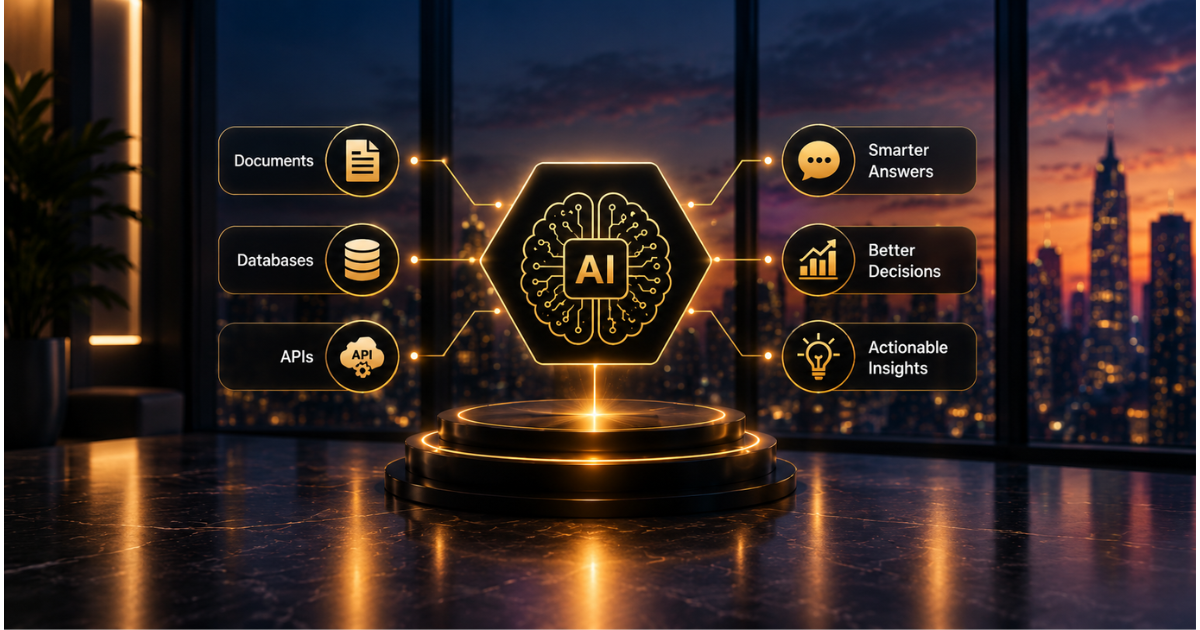
Step One: Retrieval. User asks a question. The system searches your organisational data—documents, databases, knowledge repositories, systems. But not like old search engines.
RAG uses vectorisation. Numerical representations of meaning that understand context beyond keywords.
Ask “What’s our remote policy?” and it finds remote policies, flexible work arrangements, work-from-home guidelines, even if your documentation uses completely different language.
Step Two: Generation. The retrieved documents become context. The AI reads your information and generates answers grounded in YOUR reality, not internet guesses.
Citations appear automatically. Users see exactly where answers come from. Audit trails are enabled by default. Your data stays protected because the system references only internal sources.
This two-step process transforms everything.
The Reliability Advantage Nobody Talks About
Accuracy improves dramatically. Research from leading AI laboratories shows that retrieval-augmented generation reduces factual errors by 80-90% compared with base models.
That’s not incremental. That’s transformational.
Your employees start trusting AI systems. Support costs decrease measurably. HR stops fielding repetitive policy questions. IT stops explaining procedures. Development velocity accelerates as organisational knowledge becomes instantly accessible.
This is why organisations implement RAG.
Building Foundations for RAG Success
For RAG to perform at its best, your organisation’s knowledge must be well structured. While the technology is intelligent, RAG functions most effectively with organised, clean information. Poor data quality leads to poor results, but transparency makes this clear and drives improvement.
Foundation requirements:
- Clean up orphaned documents and outdated content from your systems
- Organise information hierarchically and logically for easy discovery
- Establish metadata and tagging standards across your organisation
- Connect related information through links and cross-references
- Identify knowledge owners and establish approval workflows
- Implement governance for ongoing updates and maintenance
This is not technically complex, but it requires organisational discipline and commitment. Organisations that implement strong foundations see dramatically better RAG results. Those that skip foundation work waste the technology’s potential.
Our D365 Consulting and SharePoint and M365 implementations always include this foundational work, ensuring your RAG deployment succeeds from day one.
The Implementation Reality: Eight Steps to Success
Find your data. Which documents are most important? Which database holds critical information? Which systems store essential knowledge? Audit everything before planning.
Clean your data. Structure it. Organise it. Make it retrievable. This requires thoughtful effort, not a complete system overhaul. Most preparation involves organising what already exists.
Choose your infrastructure. Vector databases, retrieval frameworks, and integration platforms. Options are available for every budget and complexity level. Start with tools that scale with your growth.
Configure retrieval logic. Decide which information surfaces for which questions. How should documents be ranked? Which context matters most? These decisions determine system quality.
Integrate with systems. Connect to existing workflows. Make AI assistance seamless and invisible to end users. Integration determines adoption rates.
Validate thoroughly. Test with real organisational questions, real employees, and real data. Don’t cut corners here—validation prevents disasters later.
Monitor continuously. Accuracy improves over time. The system learns. Adjust as needed. Performance monitoring is ongoing, not a one-off activity.
Scale strategically. Start with one department. Prove the value. Expand methodically. Rapid scaling without validation causes problems.
Timeline expectations: Simple implementations take 2-3 months. Complex enterprise implementations with multiple integrations require 4-6 months. Most organisations realise measurable value within 8-12 weeks of production deployment.
Our Azure Integration Services guide technical architecture design, ensuring systems scale efficiently as your organisation grows. We help organisations avoid common implementation mistakes.
Why This Matters Now
By 2026, RAG-enabled AI will no longer be experimental; it is an organisational baseline. Organisations implementing RAG today gain a competitive advantage through faster decision-making, lower operational costs, and superior access to knowledge.
Early adopters in 2024-2025 will have capabilities that later implementations will take months to match.
The technology is proven. Implementations work reliably. Business cases are compelling. Our AI Enablement Programme helps organisations move systematically from experimentation to production deployment. Your competitors are likely to move already. Smart organisations do not wait.
FAQs
Does RAG require structured data, or does it work with unstructured documents too?
Both work effectively. RAG excels with unstructured documents—PDFs, emails, Word files—because they contain rich contextual information that is ideal for complex questions. Structured databases work well too.
How does RAG compare to fine-tuning models?
Fine-tuning modifies the model through training—an expensive, time-consuming process that requires expertise. RAG retrieves your data using the existing model—fast, affordable, and requiring no specialised training. For most organisations, RAG is the practical choice.
What happens if our data contains errors or outdated information?
Citations show exactly where answers originate, making poor data visible. Organisations improve data quality when the consequences become obvious. Transparency drives better governance.
Can RAG pull from multiple data sources at once?
That’s RAG’s superpower. RAG retrieves financial data from one system, documents from another, and knowledge bases from a third, then synthesises coherent answers. Multi-source integration is where RAG delivers maximum value.
How do we know RAG is working?
Track accuracy, measure usage patterns, monitor employee satisfaction, and quantify time saved compared with manual research. Most organisations see measurable improvements within weeks of deployment.