
Ask a clinician what they’d change about their workday, and a surprising number will say the typing. Not the patients, not the hours, the typing.
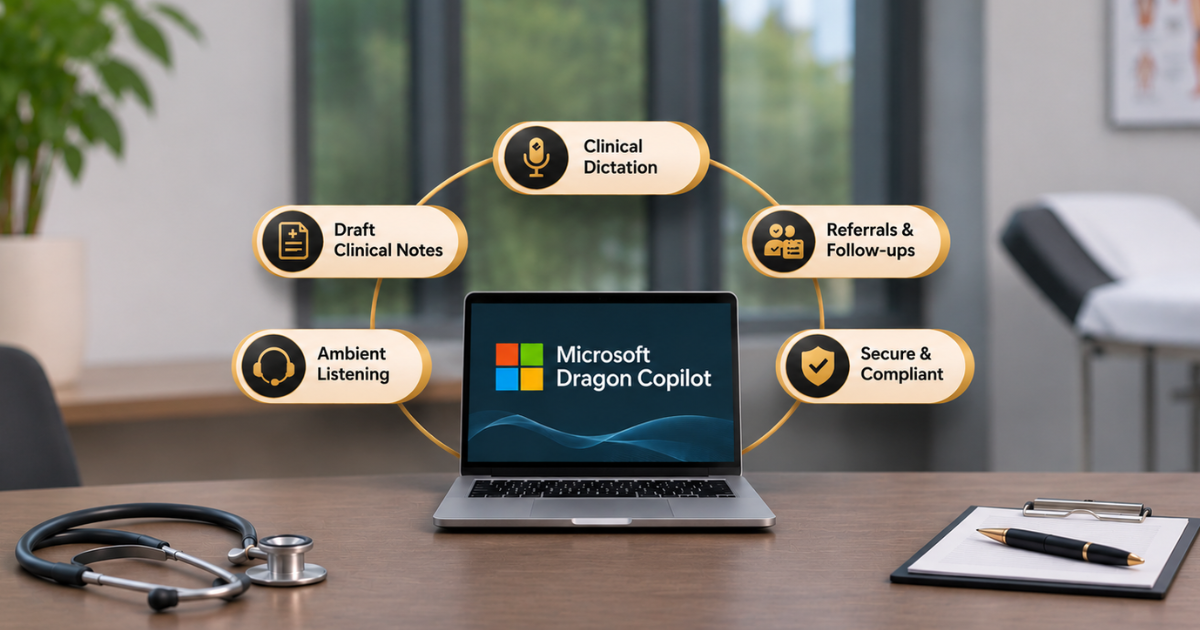
That’s the itch Microsoft Dragon Copilot is trying to scratch. It listens to the consultation, drafts the notes, handles some of the follow-up admin, and the clinician reviews them. Healthcare leaders keep asking us the same three questions: what it really does, whether we can trust it, and whether it’s worth the money.
This guide addresses them in that order. We’re a Microsoft partner, not a clinical software company, so we’ll stick to what we know: the data, the governance and the adoption of the tool.
What is its actual function?
Dragon Copilot came from two products most hospitals already knew. Microsoft launched it in March 2025 by combining the voice dictation of Dragon Medical One with the ambient listening of DAX Copilot, then adding generative AI and healthcare-specific safeguards, as Hospital Management reported.
In practice, that means a few things. It can capture a conversation in the room and draft a clinical note from it, in a format you can customise.
Clinicians who prefer to dictate can still do so and switch between dictation, ambient capture and natural-language prompts as the work demands. Microsoft also describes it as helping with referrals, after-visit summaries and information surfacing, so it isn’t only a note-taker.
At HIMSS 2026, the company went further and turned it into a platform, as Becker’s covered, with workplace context, partner-built applications and more role-based workflows.
Can we trust it?
Fair question, and the answer has two halves. One half is what Microsoft has done. The other half is what you still have to do, and leaders sometimes forget that second half exists.
Microsoft’s UK launch post says Dragon Copilot complies with UK GDPR, is hosted in a UK Azure data centre, and was assessed by a UK-based Clinical Safety Officer against the NHS DCB0129 standard.
It also states that the AI follows Microsoft’s responsible AI practices and uses clinical, chat and compliance safeguards to keep outputs accurate and safe. That’s a sensible foundation.
On your side, the supplier’s safety work doesn’t replace yours. An organisation that deploys a clinical tool has its own obligations.
Where does the value show up?
Time is the headline, but it’s rarely the whole story.
At its UK launch, Microsoft said its ambient AI had handled three million patient conversations across 600 organisations in one month, mostly in the US. That scale is notable, but the figures come from Microsoft and don’t show what the technology would do in your trust or practice.
The clinician quoted in Microsoft’s UK piece, an emergency physician at Manchester University NHS Foundation Trust, said patients feel more heard when the clinician looks at them rather than the screen. That’s a softer benefit than minutes saved, and in our experience it’s often the first thing clinicians mention.
So measure several things and measure them before you start. How long do notes take now? How much time do people spend on documentation after hours? How do staff feel about it? How often are drafts heavily edited, and for what reasons? If you don’t capture a baseline, you’ll be arguing from impressions a year later.
We use Power BI for this kind of tracking, and our guide to turning Dynamics 365 data into live Power BI dashboards shows the approach, while the Sales Bench article explains how to build a simple scorecard that works in any team.
What tends to go wrong
Training gets squeezed. Clinicians receive the tool without learning how to review a draft quickly and safely, so some trust it too much while others ignore it.
Consent and patient communication are treated as afterthoughts, even though people should be clearly told when ambient technology is in use and how their data is handled.
Some specialties receive the tool before anyone checks whether it’s right for them. Integrating it with the electronic patient record also turns out to be harder than the demo suggested.
There’s a governance gap, too. Once several AI tools are in use, someone needs to know which ones are being used, who owns each one, and what happens when one misbehaves.
Our guides to responsible AI in practice and securing AI agents with Microsoft Entra ID cover the principles, and the AI at Work roadmap we wrote for councils gives a month-by-month shape that translates well to health and care.
Before you sign anything
Start small. One service, one team, and a pilot long enough to identify a real pattern. Pick clinicians who’ll be honest when it doesn’t work, and a comparison group who aren’t using it. Agree what success looks like before the pilot starts, including what would make you stop.
Involve your information governance team from the first meeting, not the last. Make sure someone owns the data side, including who can see the recordings and drafts and how long they’re kept.
Where AI tools sit alongside broader data work, our guides to building modern pipelines in Microsoft Fabric and breaking down data silos in local government are relevant, since the same joined-up thinking applies. You’ll find more on our blog.
How we help
Our role is the work around the tool. Our AI Enablement Programme helps leadership teams plan the rollout, set up governance, train staff and measure results, and our BI and Data Science services team builds the reporting that shows whether it’s working.
As an ISO 27001 certified Microsoft partner, we treat data protection as part of the plan. Book a free assessment, and we’ll tell you honestly where to begin, no hard sell.
Common questions
What is Microsoft Dragon Copilot?
It’s Microsoft’s clinical AI assistant. It combines Dragon Medical One’s voice dictation and DAX Copilot’s ambient listening with generative AI to help draft notes, support referrals and automate some admin tasks.
Is Dragon Copilot available in the UK?
Yes. Following trials with seven organisations across the UK and Ireland, Microsoft announced general availability in the UK on 4 September 2025.
Is Dragon Copilot safe for clinical use?
Microsoft says it’s UK GDPR compliant, hosted in the UK and assessed by a Clinical Safety Officer against DCB0129. Deploying organisations still have their own obligations, and clinicians must review every draft.
Does it replace clinicians’ notes?
No. It drafts notes for the clinician to review, edit and approve.
How do we measure whether it’s worth it?
Capture a baseline first: time on documentation, after-hours work and staff experience. Then compare against it during a pilot with a similar group that isn’t using the tool.